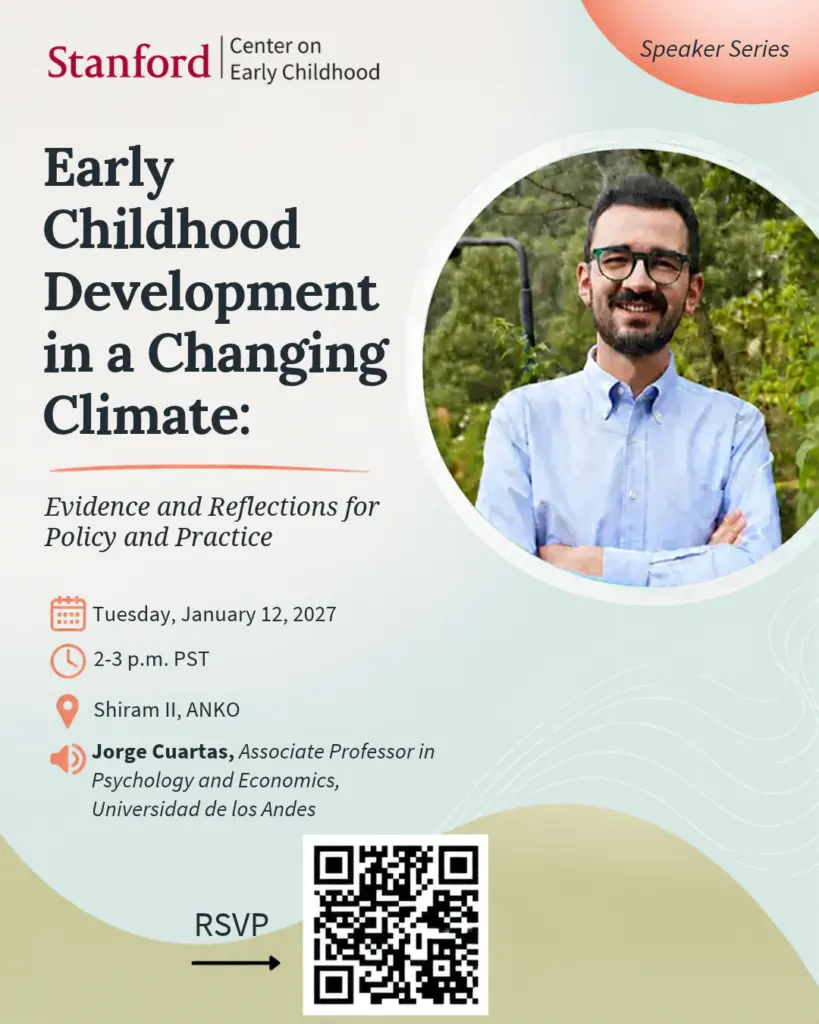
Early Childhood Development in a Changing Climate: Evidence and Reflections for Policy and Practice
- Date: Tuesday, January 12, 2027
- Time: 2:00pm — 3:00pm PST
- Location: Shriram II, ANKO
Sponsored by Stanford Center on Early Childhood
Featuring
-
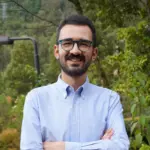
Jorge Cuartas Associate Professor in Psychology and Economics, Universidad de los Andes, Advisor
Early childhood is a sensitive period of heightened neuroplasticity, when skills built early shape lifelong trajectories. Yet nearly all young children worldwide (99%) are already exposed to climate and environmental hazards, and we know little about how climate change, particularly excessive heat, affects early development. This talk introduces a geo-bioecological model of human development that places climate and environment within the systems shaping children’s lives.
It also reviews evidence that heat may affect children through physiological stress, disrupted sleep, strained parenting, and fewer opportunities for play and learning. I then present new quasi-experimental evidence that combines Multiple Indicator Cluster Surveys (more than 20,000 mother-child dyads) with high-resolution ERA5-Land temperature data. Children exposed to average maximum temperatures above 32°C were 1.8 to 7.7 percentage points less likely to be developmentally on track than those exposed to temperatures below 26°C. Literacy-numeracy drove these effects, and they were more severe for poorer and urban households and for those without improved water and sanitation. Heat in the previous month also raised the risk of severe physical punishment (4–8 percentage points) and psychological aggression (3–4 points). I close with limitations, priorities for future research, and what it means to include young children in climate preparedness, adaptation, and resilience policy and practice.
Speaker Bio
Jorge Cuartas is Associate Professor of Economics and Psychology and Director of the CARE Lab at Universidad de los Andes. His research focuses on promoting human development, preventing violence against children and adolescents, designing and evaluating social programs and policies, and understanding the intersections between climate change and human development. His work has been published in leading scientific journals and recognized with numerous international awards and fellowships. He has served as a consultant to UNICEF, the World Bank, the Inter-American Development Bank, and the Government of Colombia, and is co-founder of Fundación Apapacho and CIMIENTOS.